In the Bag

“I would go so far as to say that the natural, proper, fitting shape of the novel might be that of a sack, a bag. A book holds words. Words hold things. They bear meanings.”

“It’s just one of those damned things you have to do in order to be able to go on gathering wild oats and telling stories.”

Just a reminder that Ursula K. Le Guin could write. Her short essay, The Carrier Bag Theory of Fiction is a well-spent 10 minute read.

2026: A Word, Please?

Mirabile dictu, another blue Thanksgiving is here. And with it, the season of lists – personal music wraps for sharing, top news stories that feel like they’re from long-ago, movie lists to stir debate, jagged charts showing the price of gas, on and on. Each one a suggestion for how the hell we can possibly frame the last twelve months of existence. Each one offering reminders of what we did in between the hours spent staring agape or slack-jawed at our phones.

The logophile community refuses to be left out of all this fun. Word nerds cannot resist a golden opportunity to debate which of the bullshitty words we made up this year deserves legitimacy.

Merriam-Webster’s Word of the Year is decided by their editors, who presumably divine the answer using tea leaves, a particle accelerator and a puff of white smoke. And they’ll announce it when they’re damn good and ready. 

But Oxford University Press is an organization of the people. They’ve nominated four contenders for your consideration and are asking you to vote. The “origin” notes contain some silliness (citing the Chinese translation of “microdrama” seems like a failed attempt at legitimizing the process) but also provide nuggets like the first known appearances of each term. 

The whole thing is probably worth a click. But just in case you’re out there, cramming in real experiences before the end of the year and pressed for time, here’s their list:

  • doomerism (n.): Extreme pessimism, especially the view that catastrophic damage to humanity from a perceived threat such as artificial intelligence or climate change is inevitable and impossible to prevent.
  • microdrama (n.): A drama series made up of very short episodes, presented in a vertical format for viewing on a smartphone, and typically featuring a melodramatic and fast-moving plot.
  • post-literate (adj.): Designating a period or society in which literacy and the importance of the written word have declined significantly.
  • slopaganda (n.): Low-quality propaganda produced using generative artificial intelligence and widely distributed online, esp. via social media.

Get your vote in before Marvel Entertainment Inc. stacks the deck for “doomerism” as a promotional stunt.

Nightly Ritual

“Because let me tell you, it’s not easy. None of it is.”

“I know,” Henry said softly. He had just come downstairs from emptying the bedside commode into the house’s toilet and rinsing it out. He looked back over his shoulder, making sure he had turned out each light he had used.

“They tell you to ‘make good decisions,’ but you’ll never know which is a good decision. Never. No one knows shit. Including you.” He waved a finger in Henry’s direction and raised his eyebrows, but never took his eyes off the TV. He rasped and wheezed as he tried to pull a pillow up from behind his lower back to his shoulder blades. The hospital bed, tilted to forty-five degrees, moaned. The oxygen machine clicked. “Even now I can’t tell what was the ‘right thing to do’ or what was a ‘missed opportunity.’ And they act like there’s just a path you need to follow.”

“It’s ok, Dad.”

“I know it’s ok. You don’t have to tell me that.” He was quiet, but it was clear he wasn’t done yet. “I’m saying this for you. Not me. I’ve learned this shit already. That’s the point.” Some moisture appeared at the corner of his mouth. “Jobs, women, houses, cars, friends, church. Even after it’s all done, there’s no way any normal person could tell what was the smart choice and what would have led to a better path. If anyone tells you otherwise, it’s horseshit.” He let out a quiet huff. Even now, he maintained a silver mane that was combed and slicked straight backwards. It took him forty minutes of struggling to make a pot of coffee, but his hair was always combed. It struck Henry as a waste of limited energy. His father pulled at the partially buttoned shirt over his once-broad physique. It reminded Henry of the once-loved car now rotting under a tarp in the backyard.

On the TV in his modified living room, the local news anchor sent it to a reporter who was where it had all happened. Henry and his father were quiet as the reporter explained what eyewitnesses had seen and what police were doing. After the reporter sent it back to the news desk, the anchors shifted their tone slightly. Soon they’d be on to sports and then weather. Then the nightly ritual would wrap up once again.

“So how’s Freddy? How’s camp going this week?”

“Fine, fine. He didn’t like the first day. Yesterday was better. But now it’s already Wednesday. Even if he hates this camp it’ll be over on Friday and he’ll be on to something else next week.”

“It wasn’t like that when I was a kid. You either. Summers were freer. Kids need that.”

“Yeah. But now you need two incomes. And you can’t leave a nine-year-old home by himself. So we do what we can.”

“Hmm. Did you hear about that camp in the Midwest?”

“Which one?”

“The one where they were pushing this big gay agenda? Encouraging the kids to… do stuff?”

“I hadn’t heard.”

“Don’t you watch the news?”

“Not really. And you should probably turn cable news off once in a while.”

“I do! Like right now!” His dad briefly shifted his eyes away from the TV.

“Yeah, but turning off cable news for a half hour of local news doesn’t really count as detoxing.” He forced a smile.

“Ahhh. Maybe. No one knows shit anyway. The older you get, the more that’s clear.”

They sat quietly for thirteen more minutes while his father snorted and chuffed at select commercials. During others, he stared absently, not blinking, miles away in his own head.

“Alright,” Henry said with an exhale as he stood. 

“You going?” 

“Yeah, I’ve got to.”

“Ok,” his father said as he shifted slightly towards his son. “You coming tomorrow?”

“Yup. Remember, use your walker if you’re trying to make it to the kitchen and keep your phone with you. And if you get winded or too dizzy, shoot me a text. I can be over to help.”

“You’ve got work.”

“Don’t worry about that.”

“Yeah, but you should worry about that.”

“Thanks Dad.”

Henry slid into his car and pulled out of the driveway. The thick late summer air invited itself into the open windows and it carried a promise of cooler weather. On the drive home, Henry thought about sacrifice and tried to decide how responsible each person is – or isn’t – for the sacrifices we make. Which of our sacrifices are chosen and which are assigned? And does the answer affect the value of the sacrifice? He decided he didn’t know. Maybe he didn’t know shit after all. 
It’s All for The Beths – Or, How to Dig so Deep into Sub- Subgenres That You Find Yourself in New Zealand

It’s dangerous to talk about musical genres; I know this. One person’s “hard rock” is another’s “heavy metal.” Are the early Beatles and Rolling Stones “pop,” “rock,” “Americana” or something else? Where do we put big acts like Led Zeppelin or small ones like G. Love and Special Sauce? For that matter, why does commercial success seem to affect genre assignment? And how the hell do you even categorize the subgenres of modern hip-hop (trap, mumble…) and alternative rock (do they even have names)? The whole topic is so subjective that you can never be sure that a conversation about music genres is a conversation about anything at all. 

But one genre is particularly slippery. For all the I-know-it-when-I-see-it music genres, “indie,” nee “college rock,” is one of the hardest to define. It really could be almost anything that isn’t mainstream. It’s filled with music that otherwise might be considered punk, post-punk, electronic, folk, or something else.  

Dig one or two layers down into the indie sediment and there runs an ever-present current of female-fronted rock artists. As far as I know, this category has never been given its own name, but it can easily be recognized when a song comes on. Alvvays, Rilo Kiley, Eliza and the Delusionals, Sleater-Kinney, Wet Leg, Courtney Barnett, etc. I’ve always found it a rewarding place to mine for new-to-me music.

Which brings us to The Beths.

Way back in 2018, while the rest of us were concerned with “God’s Plan,” living in Childish Gambino’s America and being dismissed by Ariana Grande, The Beths snuck their album Future Me Hates Me with its eponymous single into the arterioles of the music industry. I remember seeing the video and being hooked at once. The single was enough of a success to open the door to create some opportunities for a young band.

The Beths, like Taika Waititi and Flight of the Conchords, come from New Zealand where, I’ve begun to suspect, there is a particular arts school molding entertainers to exactly my preferences. Until something I do not enjoy comes from that magical country, I’ll continue to believe that some institution of higher learning has students studying curricula based on my Letterboxd ratings and Spotify lists.

Logically, The Beths’ Future Me is the place to start when exploring their music, but it’s also a great primer for their strengths. The hooky chorus of the title song gets you, while that vocal melody on the verse and pre-chorus is somehow different and perfectly familiar – traits you’ll hear throughout their catalog.

In the eight years since Future Me Hates Me, they’ve evolved without losing their way. The latest album, Straight Line Was a Lie, is evidence. The songs have a quiet confidence and sincerity without taking themselves too seriously. This is who they are. Need more proof? Check out the videos from their latest tour. Each night started without a set list. Fans wrote requests on paper airplanes and threw them onto the stage and the night evolved from there.  

So much indie music feels like it was made to choose between heavy seriousness and light accessibility. Depression or dancing. The coffeehouse or the bar. Somehow, The Beths consistently give you both. And they seem to keep getting better.

Concepting

The leaves have changed colors and given up. The sun and birds are spending their time elsewhere. It’s the time of year for concept albums.

For whatever reason, it’s easier to embrace and enjoy albums that tell stories or follow themes in the fall and winter. So, as a public service, please enjoy this list of the top concept albums, in no particular order:

  • Coheed and Cambria – In Keeping Secrets of Silent Earth: 3 (Spotify link)
    • You could start with any of the albums in the series, or almost any Coheed album to jump into an ongoing story. But this one has the most songs that stick in your head.
  • Deltron 3030 – Deltron 3030 (Spotify link)
    • Del the Funky Homosapien is among the most underrated rappers. Yes, the story is a bit crazy, but the lyrics and flow are undeniable.
  • Dream Theater – Octavarium (Spotify link)
    • Do you remember that scene in the movie Contact where they realize the ability to decode the complicated message from the aliens was IN the message?
  • Dream Theater – Metropolis Pt. 2: Scenes from a Memory (Spotify link)
    • Prog rock can be divisive and mood-dependent. But damn, is the music amazing. And the story is interesting enough while still being comprehensible in the first or second listen.
  • My Chemical Romance – The Black Parade (Spotify link)
    • Twenty years on, and it still brings goosebumps. Every time.
  • Pink Floyd – The Wall (Spotify link)
    • The daddy of them all. You can hear the inspiration of The Wall on at least three other albums on this list. And spare me your what-about-Dark-Side-ism. The Wall is longer, is more enjoyable, follows a story arc and has a wider musical variety than Dark Side. And so help me if you bring up the Wizard of Oz thing.

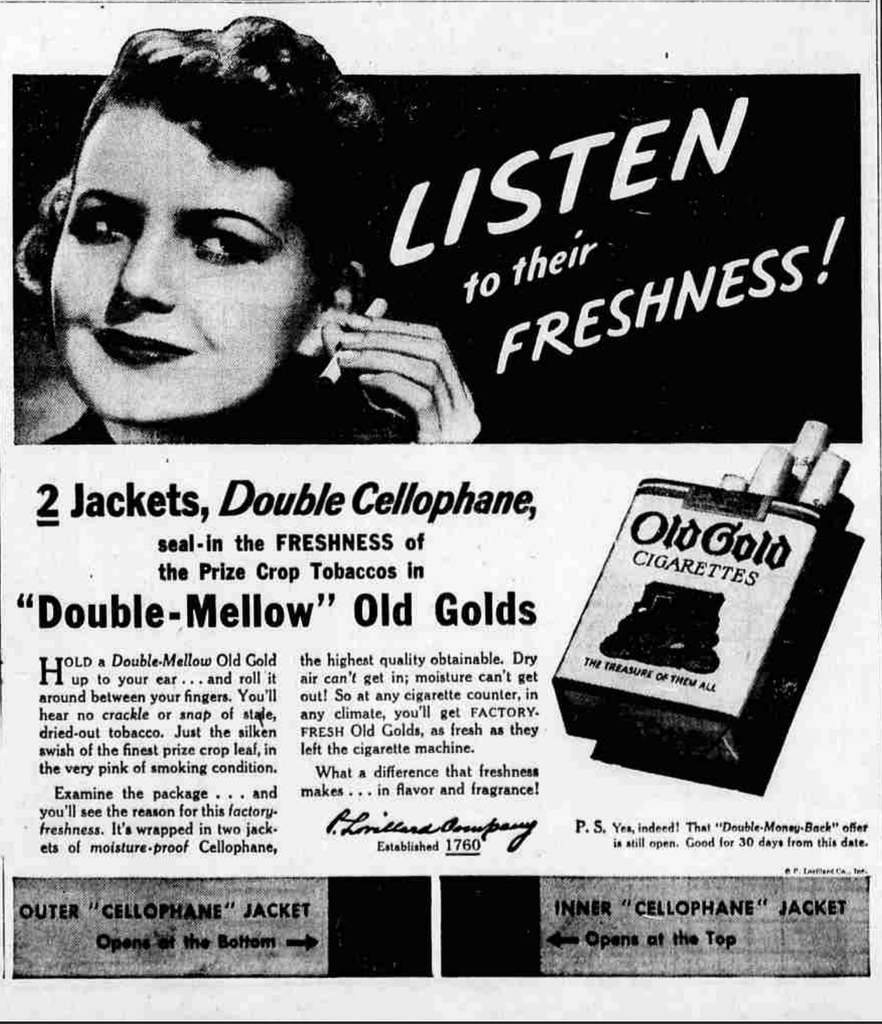
Advertising Gold

A tip of the cap to the long-gone marketing person who came up with the concept of listening to your addiction, but who trusted their audience enough to understand the implication without having the actual words on the page.

Just try not to stare into the sinister eyes of the model – or consider that if you cut the copy out of this ad, it looks like it’s for a horror movie about evil, talking smokes.